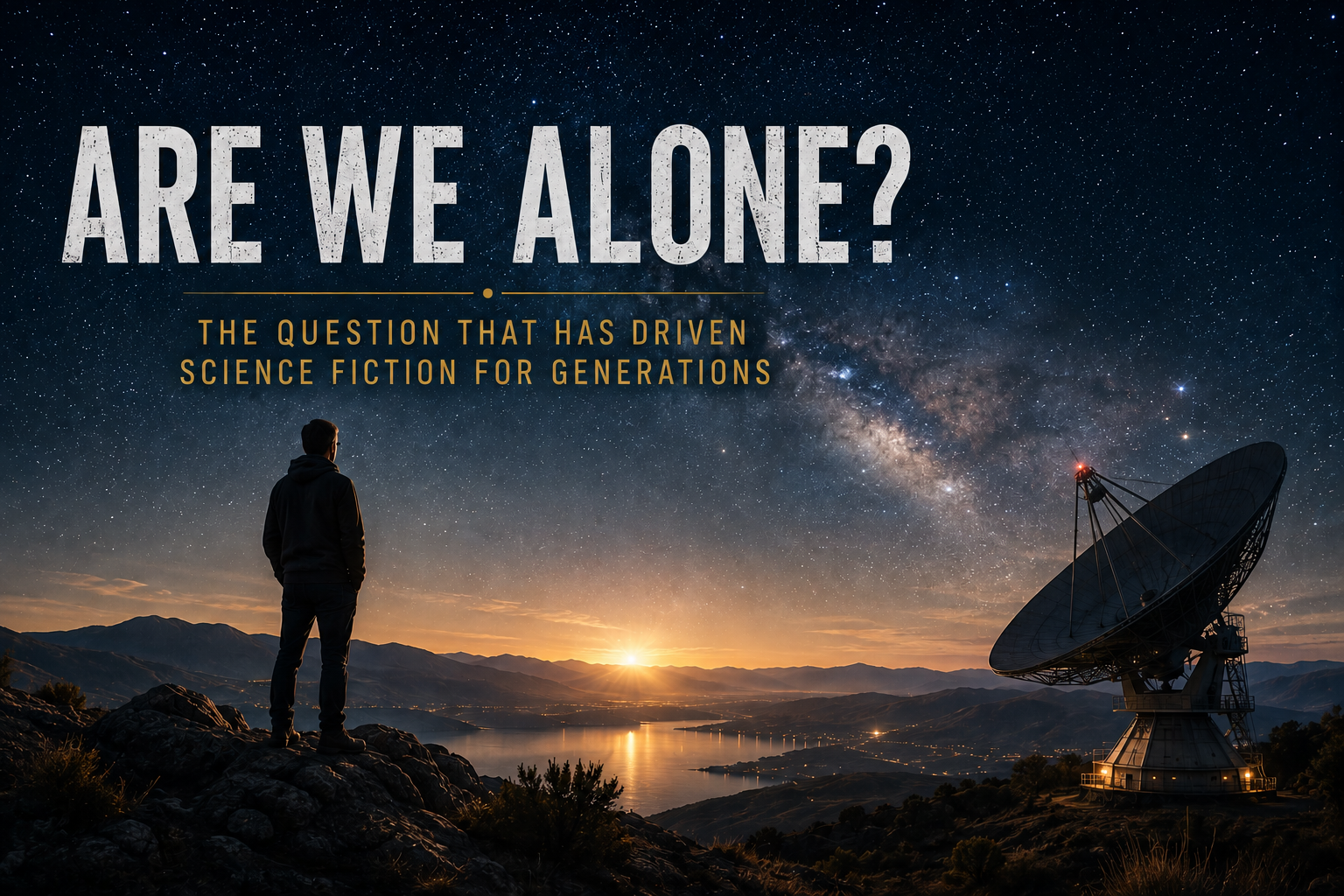
Go outside on a clear night and look up.
If you can get far enough away from the city lights, you’ll see thousands of stars. When I was a kid, that seemed like an incredible number.
Now we know we’re only seeing a tiny fraction of what’s actually out there.
The Milky Way has hundreds of billions of stars, and our galaxy is only one of an enormous number scattered across the universe.
It’s hard for me to look at numbers like that without eventually asking the obvious question.
Are we really the only ones here?
I’ve wondered about that for most of my life.
Science fiction certainly helped. I grew up reading Isaac Asimov, Arthur C. Clarke, Piers Anthony, Ursula K. Le Guin, and just about anything else I could get my hands on. Then there was Star Trek and Star Wars, which took the question in completely different directions.
Back then, planets around other stars were mostly something I read about in science fiction.
Today we’ve found thousands of them.
And that changes the question.
This still amazes me.
When I was growing up, we knew our solar system had planets. We assumed other stars probably had them too, but nobody had actually confirmed one.
Now we know planets are common.
We’ve discovered thousands of exoplanets, and there are almost certainly billions more just in our galaxy.
Some of the ones we’ve found are pretty strange.
There are giant planets orbiting extremely close to their stars. There are planets where a year lasts only a few days. There are worlds much larger than Earth and others closer to our size.
We’ve also found rocky planets.
Some orbit at distances where liquid water might be possible if the other conditions are right.
That doesn’t mean we’ve found another Earth.
Being the right distance from a star doesn’t tell us whether a planet has oceans, breathable air, life, or anything else we’d recognize.
But it does tell us something.
Earth isn’t the only planet.
Our solar system isn’t unusual because it has planets.
They’re everywhere.
So where is everybody?
The universe is about 13.8 billion years old.
Earth is about 4.5 billion years old.
There were billions of years available for other planets and possibly other civilizations to exist before our planet even formed.
Let’s say another intelligent species appeared somewhere in our galaxy a million years before us.
A million years is almost impossible to imagine when you’re talking about human history.
When you’re talking about the universe, it isn’t much time at all.
Now look at what we’ve done in barely more than a century.
In 1903, the Wright brothers managed to get an airplane off the ground for a few seconds.
Sixty-six years later, we were standing on the Moon.
Today we have robots on Mars. We have spacecraft that have traveled beyond our solar system. Thousands of satellites orbit Earth. We’re studying the atmospheres of planets around other stars.
I can sit at home with a phone in my hand and instantly communicate with someone on the other side of the planet.
None of this would have seemed possible very long ago.
So what happens after another thousand years?
Ten thousand?
A million?
I don’t have the slightest idea.
And that’s what makes this so interesting.
If another civilization had a million-year head start, shouldn’t we see something?
That’s basically the problem behind what’s called the Fermi Paradox.
If there are so many stars and planets, and the universe has had so much time, why haven’t we found anyone?
There are plenty of possible answers.
Maybe life is rare.
Maybe intelligent life is rare.
Maybe civilizations don’t last very long.
Maybe everybody is too far apart.
Maybe we’re looking for the wrong things.
Or maybe somebody already knows we’re here.
I don’t know which answer is right.
Nobody does.
That’s what makes it such a great question.
One possibility is that simple life isn’t unusual at all.
Maybe there are bacteria under the surface of Mars.
Maybe something is swimming in an ocean beneath the ice of Europa.
Maybe planets all over the galaxy have some form of life.
But life and intelligent life are two very different things.
Look at Earth.
Life has been here for billions of years.
For almost all of that time, nothing was building cities, writing books, using radios, or wondering what was happening on another planet. At least there is no sign of it?
Dinosaurs were incredibly successful.
They were here for more than 160 million years.
As far as we know, none of them ever looked through a telescope.
Intelligence like ours may not be an inevitable result of evolution.
It may be incredibly rare.
Maybe there are living worlds everywhere and almost none of them ever produce a civilization.
That’s possible.
There’s another possibility.
Maybe Earth really is unusual.
We still don’t know how difficult it is for life to begin.
That’s one of the things I find amazing about this whole subject. We know life happened here, but we don’t know whether it was practically inevitable or whether we won some ridiculous cosmic lottery.
We have one example.
Earth.
That’s it.
If we found completely independent life somewhere else in our own solar system, even if it was nothing more than a microorganism, that would be enormous.
We would suddenly know that life didn’t begin only once. It had independently emerged on at least two different worlds. And if life managed to begin twice in one solar system, a universe filled with life would become much easier to imagine.
Until then, we’re trying to figure out how common life is with a sample size of one.
This one is harder to think about.
Maybe intelligent civilizations appear fairly often.
They just don’t survive very long.
Look at humanity.
The more technologically advanced we become, the more ways we find to hurt ourselves.
Nuclear weapons.
Biological weapons.
Environmental damage.
Artificial intelligence.
And whatever comes next.
Our technology has advanced incredibly fast.
I’m not convinced we’ve become equally better at making good decisions.
Maybe that’s normal.
Maybe every technological civilization eventually reaches a point where it becomes powerful enough to destroy itself.
There’s an idea connected to the Fermi Paradox called the Great Filter.
Somewhere between a dead planet and a civilization capable of spreading among the stars, there may be a step that’s incredibly hard to get past.
The beginning of life might be the filter.
Complex life might be the filter.
Intelligence might be the filter.
Or the dangerous part might come after a species develops advanced technology.
That’s the part I don’t particularly like.
Because we don’t know whether the Great Filter is behind us.
Maybe we’ve already done the hard part.
Or maybe it’s still ahead.
There’s also a much simpler explanation.
Maybe everybody is just too far apart.
The nearest star system to us is more than four light-years away.
That’s close by astronomical standards.
Light travels about 186,000 miles every second, and it still takes more than four years to reach our closest stellar neighbor.
The Milky Way is roughly 100,000 light-years across.
Imagine we detected a signal tomorrow from a civilization 1,000 light-years away.
That signal left their planet a thousand years ago.
We wouldn’t be hearing them as they are today.
We’d be hearing their past.
If we sent a response, it would take another thousand years to reach them.
Then we’d wait another thousand years for their reply.
Human beings aren’t particularly good at waiting five minutes for someone to answer a text message.
I’m not sure we’re built for a 2,000-year conversation.
This is one of the explanations I like the most.
We’re searching for alien civilizations using human technology.
Radio signals.
Lasers.
Atmospheric changes.
Maybe giant structures.
Basically, we’re looking for things we know how to recognize.
But why would a civilization a million years ahead of us still be using technology we understand?
We’ve only been using radio for a little over a century.
Maybe advanced civilizations used radio for a few hundred years and then moved on to something completely different.
Something we don’t even know exists yet.
We might be listening to an enormous universe filled with communication and hearing nothing because we’re using the wrong equipment.
It would be like searching modern St. Louis for smoke signals and deciding nobody lives there because you don’t see any.
Maybe the universe isn’t quiet.
Maybe we just don’t know how to listen.
We also tend to imagine aliens as creatures.
They have arms.
Eyes.
Heads.
Spaceships.
Maybe they breathe something different from us, but they’re still basically organisms traveling around in machines.
Why?
We’re already developing artificial intelligence, robotics, genetic engineering, and brain-computer interfaces.
We’re at the very beginning of all of this.
Imagine where those technologies might lead after a thousand years.
Then imagine a million.
Would an advanced civilization still be biological?
Would it need oxygen?
Water?
Food?
Would it even need a planet?
Maybe the most advanced civilizations in the universe aren’t biological anymore.
Maybe the distinction between machine and living organism stopped mattering to them a long time ago.
If that’s true, we may not even recognize what we’re looking for.
This is the possibility I keep coming back to.
We always talk about humanity finding extraterrestrial life.
What if somebody else found Earth first?
Our planet has been showing signs of life for a very long time.
Life changed our atmosphere.
Plants eventually filled it with oxygen.
We’re only beginning to develop the ability to study the atmospheres of planets around other stars.
Imagine what we’ll be able to do in another thousand years.
Now imagine a civilization that reached that point a million years ago.
They might have known Earth was alive before humans existed.
Before us, they could have watched dinosaurs.
Mass extinctions.
The rise of mammals.
Ice ages.
Then something strange happened.
One species started changing the planet very quickly.
Cities appeared.
Artificial lights covered the night side of Earth.
Radio signals started leaking into space.
Machines began orbiting the planet.
Eventually we started sending spacecraft beyond Earth.
If someone had already been watching, humanity would have become noticeable very quickly.
Which leaves me with another question.
If they know we’re here, why haven’t they contacted us?
Maybe they don’t want to.
We already debate how much we should interfere with isolated cultures here on Earth.
Imagine finding a civilization thousands or millions of years behind us technologically.
Would giving them our technology help them?
Or would we destroy their society?
Maybe an advanced civilization would have rules about that.
Science fiction has played with this idea for years. Star Trek has the Prime Directive, which prevents interference with developing civilizations.
Obviously that’s fiction.
But the idea makes sense.
Maybe civilizations have to reach a certain point before anyone contacts them.
Maybe they have to become capable of leaving their own solar system.
Maybe they have to prove they can survive their own technology.
Or maybe nobody cares enough to call us.
That’s possible too.
There’s another possibility that I don’t hear discussed nearly as much.
What if humanity isn’t late?
What if we’re early?
We usually imagine the galaxy being filled with ancient civilizations that have been traveling between stars for millions of years.
But the universe isn’t finished.
Stars will continue forming for an incredibly long time.
There could be intelligent civilizations that won’t exist until long after humanity is gone.
Maybe the galaxy isn’t already filled with ancient societies.
Maybe we’re part of the first group.
I like this possibility because it completely changes our place in the story.
Instead of eventually discovering some galactic civilization that’s been around forever, maybe humanity becomes one of the civilizations that helps build it.
Maybe someday another species will look toward our part of the galaxy and ask:
Are we alone?
And we’ll be the ones answering.
I’ve been reading science fiction for most of my life.
Asimov made me think about civilizations spread across enormous distances and stretches of time.
Arthur C. Clarke made me think about what happens when we encounter something so advanced that we don’t understand it.
Ursula K. Le Guin made alien cultures feel like more than just humans wearing different faces.
Then there was Star Trek, where humanity eventually grows up enough to become part of something much larger.
Those stories stayed with me.
Not because I thought they were predicting the future.
Because they made me wonder what was possible.
That’s what I’ve always loved about science fiction.
Take something real.
Then ask:
What if?
The question of whether we’re alone is part of what eventually led me to The Inheritance War.
But I wanted to turn the question around.
Instead of humanity discovering another civilization somewhere across the galaxy, what if somebody else already knew about us?
What if Earth wasn’t being discovered?
What if it was being revisited?
And what if humanity wasn’t the first intelligent society that ever existed on Earth?
What if we’re just the current one?
That’s where the science ends and I get to start making things up.
There is currently no confirmed scientific evidence that an extraterrestrial civilization exists.
We’ve discovered thousands of planets.
We’ve found organic molecules in space.
We know many of the ingredients associated with life exist beyond Earth.
But we haven’t found another living thing.
Not yet.
So after all of the telescopes, spacecraft, mathematics, theories, and searching, we’re still left with the same question people have been asking while looking at the night sky for thousands of years.
Are we alone?
Maybe.
Maybe not.
I hope I live long enough to find out.
But there’s another question I find even more interesting.
What if they already know we’re here?
And if they do…
what are they waiting for?
D. M. Bachmann is the author of The Inheritance War, a science-fiction novel exploring first contact, deep time, humanity’s origins, and the possibility that we may not be the first intelligent society to call Earth home.